SNAP Rapid Response Update
Our Vice President of Community Impact, Brett Martin, shared this update about UWKV's community responses to the federal delay in food assistance. With the restoration of funding, these particular efforts will be winding down. We will share results and data in an upcoming newsletter.
During the month of October, we learned that SNAP benefits would be suspended for recipients. Over the last two weeks of October and the first week of November, we navigated a very fluid situation. We worked with policy experts at the state level who were monitoring the actions and communications from all three branches of government at the federal level to help us understand the actions and anticipate what was ahead.
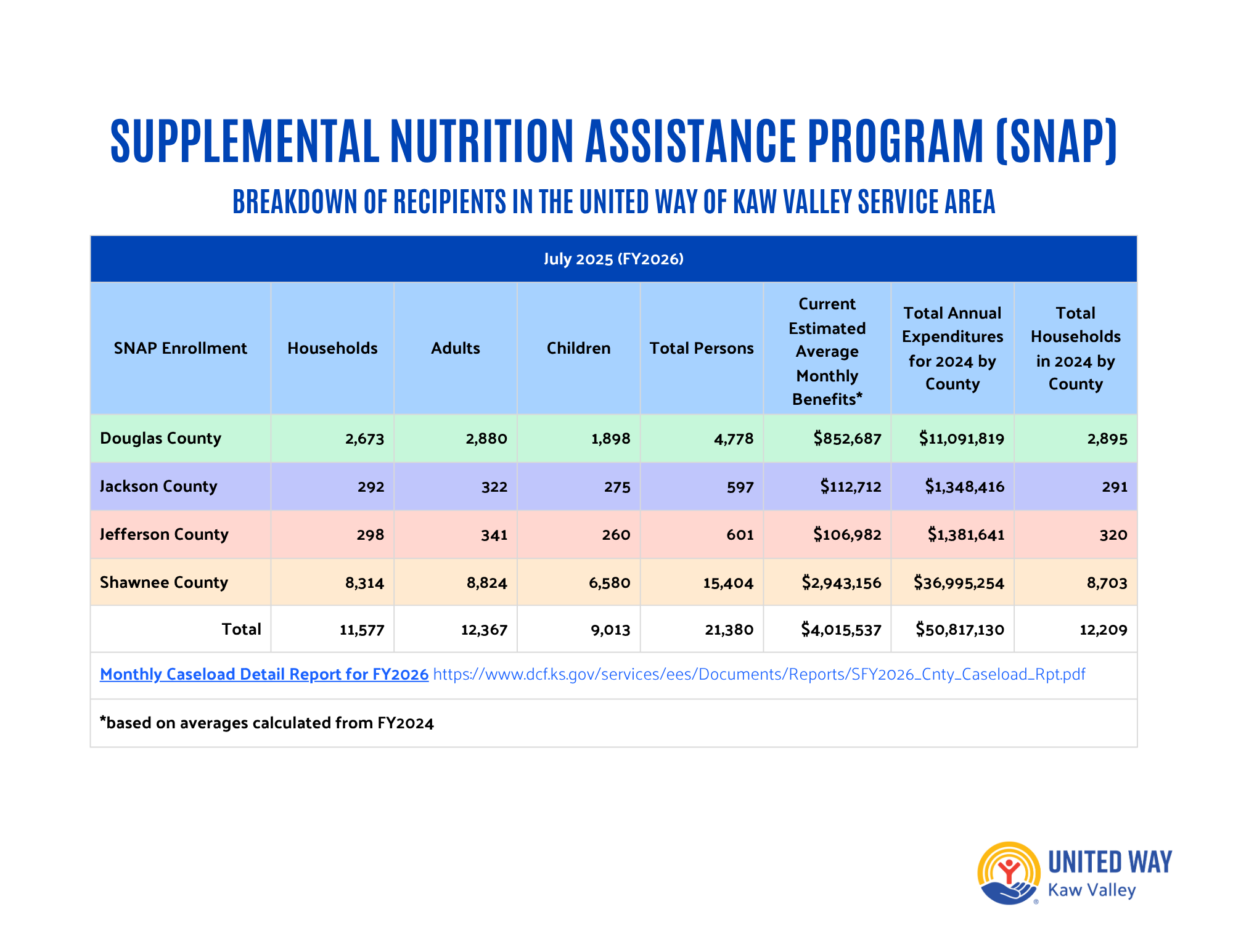
Additionally, we gathered data on the average amount of SNAP assistance for all counties. The data is included below:
Below are the ways we worked with local partners to skillfully intervene during this crisis.
DOUGLAS COUNTY
In Douglas County, we gathered with community partners to learn about opportunities to mobilize. Partners there worked with Just Food, the local food distribution hub, to supply other pantries. The community launched a fundraising campaign called the Douglas County United Food Pantry Response Fund at the Douglas County Community Foundation. These efforts raised more than $75,000 to support food security in the county. Thanks to Just Food, the Ballard Center, and the Douglas County Community Foundation for leading these efforts. We provided support to recruit volunteers through kawvalleyvolunteers.org, our online volunteer engagement portal.
JACKSON AND JEFFERSON COUNTIES
In Jackson and Jefferson Counties, we worked to update information for food pantries in those areas. We want to extend a special thanks to Angie Strecker, a member of the Shawnee County Advisory Council, for her work on this project. Additionally, we met with Jackson County community members in November to talk about food security and food access in the county.
SHAWNEE COUNTY
In Shawnee County, we co-convened a meeting with LiveWell Shawnee County hosted by the City of Topeka to develop strategies to make food accessible to individuals and families. More than 50 entities gathered to mobilize efforts. Out of that meeting, we developed the Oh SNAP Campaign to respond to the needs in the community. You can find a landing page for that campaign here: www.uwkawvalley.org/ohsnap.
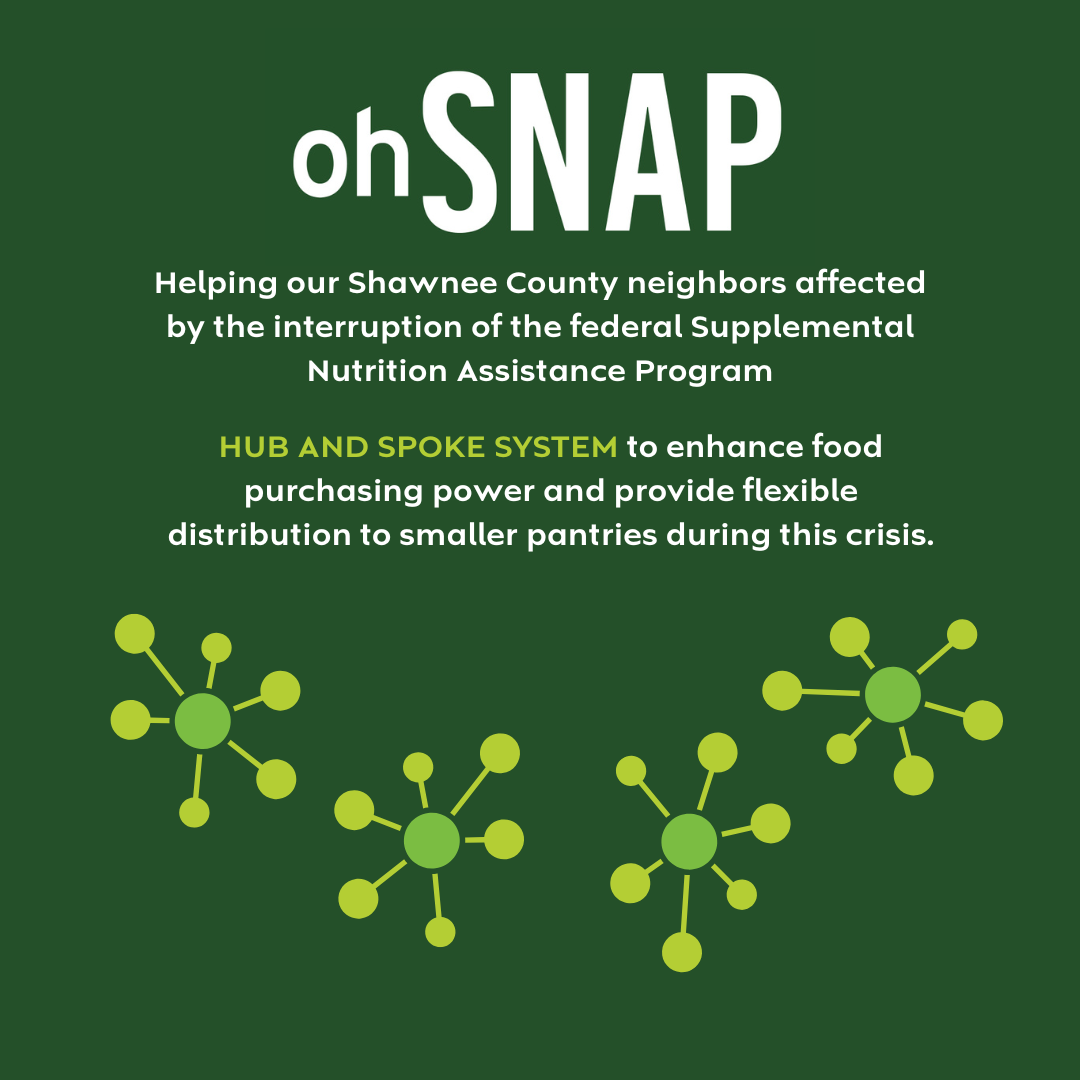
Beyond that, we designed a hub and spoke model to leverage the buying power and capacity of key food pantries (hubs) to support smaller pantries throughout the county (spokes). Generous donations from individuals and companies, as well as a partnership with the City of Topeka, funded this effort. This work continues as we are working with the hubs and spokes to get food to families even though SNAP benefits have been reinstated. Before this SNAP crisis, we heard from families that they were struggling to afford food because of rising grocery prices. The families who are accessing food through our hub and spoke model share similar stories. The financial investment in this model is helping families bridge the gap by providing food that ensures their family can stretch the dollars in their budgets to cover housing, medical care, and other necessary expenses.
While the stories of families needing assistance are heartbreaking, we continue to be inspired by the community's response. We have heard from state-level partners that what is happening among the partners in Shawnee County is rare, and they wish other communities could collaborate like this. Every week, we host the Tuesday call, a space where nonprofits, funders, state and local government, private business, and others come together to share information and develop strategies to serve our community in more effective and efficient ways. Each week, we start the meeting by saying "remember that in this meeting titles are left at the door, agency names are left at the door, and we place the community at the center of our work." The hub and spoke model that has formed among food security partners during this SNAP crisis is a great example of leaders doing just that - placing the community at the center of our work. We are grateful to all of those who have said "yes" and responded to this call to action.
This intervention has produced some great results, proving once again that we can do more together than we can separately.
Thanks to the community for your trust and investment in us and in our partners.